24 Dec 2025
How Are Masks Cleaned and Maintained?
Protective masks used in working environments that may endanger human health are among the most important safety equipment. Respiratory protective masks are used in industrial work areas, chemical environments, the healthcare sector, and many areas of daily life. Of course, in this process, masks must be used correctly and cleaning and maintenance procedures must be completed properly. In this way, the mask’s filtration performance will not decrease and the person’s risk of exposure to dangerous particles will be eliminated.
Points to Consider in Mask Cleaning
Manufacturers have introduced their own models regarding protective masks. Therefore, mask cleaning must be carried out according to the manufacturer’s instructions. There are special maintenance methods for different mask types. Cleaning the mask properly;
- Extends the service life of the mask.
- Keeps filtration performance high.
- Prevents skin irritation and bacterial buildup.
- Minimizes safety risk.
In mask use, appropriate cleaning methods should be applied according to the mask type.
How Are Washable Masks Cleaned?
Some masks have the feature of being used several times. These are defined as washable masks, and the cleaning steps are as follows;
- First, the mask should be removed without touching the front surface.
- The water to be used for washing must be 60°C and above.
- Soap and detergent can be used during washing.
- The drying process should be under the sun or in a machine at high temperatures.
- The protective mask must never be used while it is wet.
- For filtered masks, the filter section must never be washed; the filter must be replaced.
Cleaning of N95, FFP2, FFP3 Masks
N95, FFP2 and FFP3 masks defined as single-use,
- In case of washing, spray cleaning and disinfection, the filtration capacity of the mask will decrease.
- Must never be immersed in water.
- Chemical cleaning must not be performed.
- UV or oven methods are not recommended.
- In case of contamination or getting damp, it must be replaced with a new one.
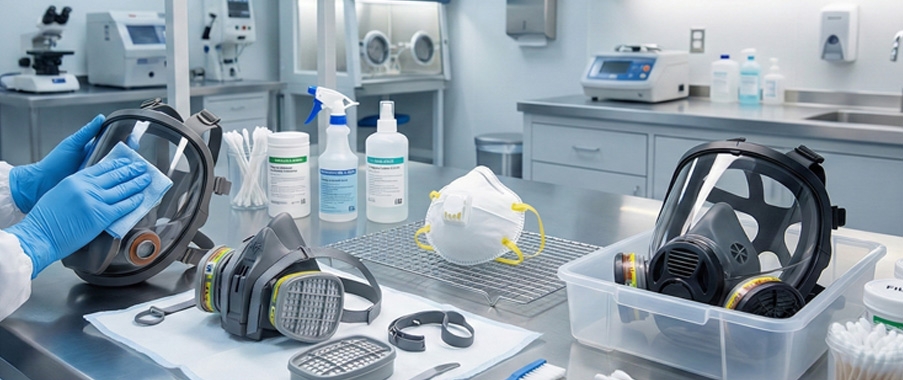
How Should Reusable Filtered Masks (Half and Full Face Masks) Be Cleaned?
Half face half-face) and full face masks are used in chemical and industrial environments. The cleaning of these masks must be done periodically. Half and full face masks are designed for multiple uses. Regular cleaning of the body part and timely replacement of the filter are important. The recommended cleaning steps are as follows;
- First, the filter cartridge is removed.
- The mask body is washed using warm water and mild soap.
- Abrasive substances must never be used.
- After rinsing, the mask is left to dry.
- The filter section must never be washed; it is only replaced with a new one.
Cleaning and Replacement of Filters
Respiratory protective mask filters are not cleaned. In case of contamination and wear, they must be replaced with a new filter. Dust, gas and combined filters in masks have a certain service life. The signs indicating that the filter needs to be replaced are as follows;
- Breathing starts to become difficult.
- The sensation of chemical odor increases.
- The usage period recommended by the manufacturer expires.
- The filter becomes damp or gets damaged.
Common Mistakes in Mask Maintenance
Although mask maintenance procedures are extremely important, there are some mistakes made in this process. These practices render the mask ineffective and shorten its service life;
- Washing the protective mask with bleach
- Cleaning the filter part with hot water
- Spraying disinfectant on the mask
- Disinfection at home with UV light
- Drying the filter in the sun and using it again
Storage Conditions for Protective Masks
Masks that are cleaned properly should be stored under suitable conditions. It is not recommended to leave the mask in an open area or inside a vehicle after cleaning. Instead;
- It should be placed in a dust-free ventilated container.
- It should be positioned in a place that does not receive direct sunlight.
- It should be kept away from chemical contents.
- Filters must definitely be stored in sealed packaging.
- It should be kept away from humid environments.
Protective mask cleaning is actually quite easy. Only in this process, periodic maintenance and cleaning procedures must be done correctly. For professional mask maintenance, following the manufacturer’s instructions will be sufficient.
Similar Content
-
 Gas Mask Selection Guide
 -
 How to Choose a Gas Mask Filter?
 -
 Why Does Your Mask Become Ineffective?
 -
 Invisible Danger: Why Do All Mask Standards Say "0.3 Micron"?
 -
 Mask Certifications Guide: Who Are You Entrusting Your Breath To?
 -
 Special Respiratory Masks for Chemical Environments
 -
 How Are Masks Cleaned and Maintained?
 -
 When Should the Filter Replacement Period Be for Masks?
 -
 In Which Sectors Are Respiratory Protective Equipment Used?
 -
 How Should Mask Usage Training Be Provided to New Employees?