08 Jan 2026
Mask Certifications Guide: Who Are You Entrusting Your Breath To?
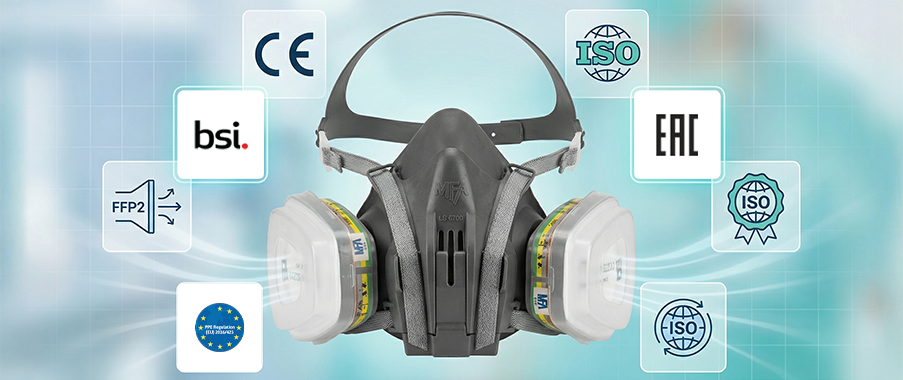
Respiratory protective masks are not just simple accessories; they are "personal shields" of vital importance from industrial areas to the healthcare sector. But how can you tell whether a mask truly protects you?
As a manufacturer, we have transparently compiled for you what the letters and numbers on the mask (CE, EN, N95) mean and how to choose the right mask.
1. Our Passport: What Is the CE Mark?
The CE mark you see on the mask indicates that the product has been manufactured in compliance with the relevant European Union legislation and standards, and that the manufacturer declares this compliance.
If a mask has a CE mark, this means:
- Strict Inspection: The production process has been regularly inspected.
- Proven Performance: The mask has successfully passed filtration tests in a laboratory environment.
- Legal Compliance: It fully meets health and safety criteria.
Manufacturer Note: In the Turkish market, having a CE mark on an occupational safety mask sold is a legal requirement.
2. What Do Technical Standards (EN) Tell Us?
The "EN" (European Standard) codes determine which tests your mask has passed. As manufacturers, we design masks according to these standards:
- EN 149 (Dust Masks): FFP1, FFP2 and FFP3 class, foldable or molded masks.
- EN 140 (Half Face Masks): Reusable bodies with replaceable filters.
- EN 143 (Particle Filters): Dust filters attached to masks (P1, P2, P3).
- EN 14387 (Gas Filters): The standard for filters that provide protection against chemical gases.
3. The N95 Myth and NIOSH (American Standard)
NIOSH, which we heard frequently during the pandemic period, is the U.S. National Institute for Occupational Safety and Health. Respiratory protective masks used in the USA are tested and approved by NIOSH.
According to this standard, masks are classified according to both filtration efficiency and resistance to oily environments:
- N Series (N95, N99, N100): Provides protection against non-oil particles.
- R Series: Has limited-time resistance to oily particles.
- P Series (P95, P100): Fully resistant to oily particles.
Here, the numbers indicate the filtration rate:
N95 = at least 95% filtration
Did you know? The European standard FFP2 shows very similar characteristics to the American N95 in terms of performance. Both provide filtration in the 94-95% range. Therefore, although the two standards are applied in different countries, in practice the levels of protection they offer to the user are quite close.
4. Which Mask Should You Choose in Which Environment?
For correct protection, it is essential to know the type of risk in the environment. For this, please take a look at our risk guide.
5. Why Is a Non-Certified Mask Dangerous?
Masks that do not have a CE mark, an EN standard, or a valid certification code on them are never suitable for professional use.
When you use a non-certified mask:
- You may think it is filtering, but you may continue to inhale toxic particles.
- Your breathing becomes difficult and you get tired quickly.
- It does not fit your face completely and does not provide sealing.
In Conclusion;
Your breath is your most valuable asset. As manufacturers, we certify our masks by subjecting them to the toughest tests in international laboratories. In your working environment, always choose certified, barcode-verifiable, and reliable brand products.
Similar Content
-
 Gas Mask Selection Guide
 -
 How to Choose a Gas Mask Filter?
 -
 Why Does Your Mask Become Ineffective?
 -
 Invisible Danger: Why Do All Mask Standards Say "0.3 Micron"?
 -
 Mask Certifications Guide: Who Are You Entrusting Your Breath To?
 -
 Special Respiratory Masks for Chemical Environments
 -
 How Are Masks Cleaned and Maintained?
 -
 When Should the Filter Replacement Period Be for Masks?
 -
 In Which Sectors Are Respiratory Protective Equipment Used?
 -
 How Should Mask Usage Training Be Provided to New Employees?