26 Dec 2025
Special Respiratory Masks for Chemical Environments
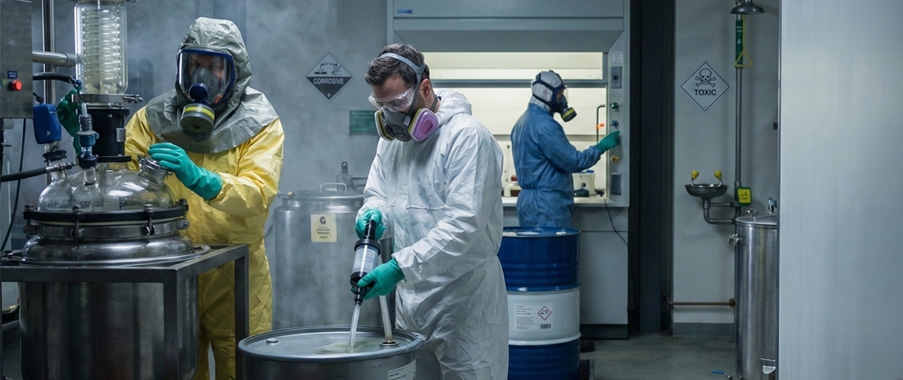
Special respiratory masks are of critical importance for personnel working in chemical environments. Gases, vapors, toxic particles, aerosols, and chemical substances in the air do not pose a health risk by being trapped in the filter of protective masks. Special respiratory masks have been developed for many chemical environments such as industrial production, the chemical industry, laboratories, pharmaceutical factories, and waste disposal facilities. In this context, the correct mask selection should be made and it should be used correctly as well.
Why Are Chemical Environments Dangerous?
Chemical environments involve risks that can damage a person’s respiratory system. The health problems that may occur in this case are as follows;
- Chemical burns
- Poisoning
- Lung irritation and edema
- Chronic respiratory diseases
- Organ damage
- Carcinogenic effect
Such serious health problems cannot be prevented by standard dust masks. In this context, special system masks with the ability to filter the inhaled air should be preferred.
Types of Protective Masks for Chemical Environments
Different types of masks must be used depending on the chemical environment a person is in.
Half Face Gas Masks
Half face masks that provide protection against solvent vapors, gases, and low-concentration chemicals cover the nose and mouth. In addition, the chemical filter cartridges of this mask are replaceable.
Areas of Use of the Half Face Mask;
- Paint production facilities
- Solvent applications
- Chemical studies in laboratory environments
Full Face Gas Masks
They are quite effective against medium and high concentration chemicals. Due to their structure, they cover the entire face. In this way, the eye area is also protected from chemical vapor.
Advantages of full face gas masks;
- Provides high sealing.
- Protects the eyes and surrounding area.
- Has a wide range of filter options.
Chemical Filter Respiratory Masks
In these masks, there are color-coded cartridges according to the type of chemical. These can be listed as follows;
- A: Organic gases and vapors
- B: Inorganic gases
- E: Acid gases
- K: Ammonia and derivatives
- P: Particles
Choosing the correct filter among these will provide high safety in a chemical environment.
Important Warning: Carbon monoxide (CO) gas is colorless, odorless, and extremely toxic. Standard gas and vapor filters (A, B, E, K type filters) do not provide protection against carbon monoxide gas. In environments where there is a risk of CO, only independent air-supplied respiratory devices should be used.
Self-Contained Breathing Apparatus (SCBA)
In environments where the oxygen level is low and the chemical concentration is high, self-contained breathing apparatus is used. Thanks to the cylinders on it, it provides an independent air source for the person.
Areas where self-contained breathing apparatus is used;
- Chemical leakage situations.
- All environments where toxic gases are present.
- The first response process after a fire.
Vital Warning: Respiratory masks with gas and particle filters are not used when the oxygen level in the ambient air drops below 19.5%. In such environments, filtered masks do not provide oxygen and there is a risk of suffocation. In areas with low oxygen levels, only independent air-supplied breathing systems (SCBA) should be used.
Points to Consider When Choosing Special Respiratory Masks for Chemical Environments
The most accurate selection must be made among special respiratory masks for chemical environments. Determining the necessary risks and selecting the appropriate protective mask accordingly is very important. The main points to consider can be listed as follows;
- The type of chemicals must be determined.
- The compliance of the protective mask with international certifications and standards such as EN or NIOSH should be checked.
- The gas/vapor filter class of the mask should be selected.
- Factors such as filter capacity and replacement time should be determined.
- The mask and filter must be compatible.
- Depending on the work being performed, a full face or half face mask should be selected.
- A fit test should be performed.
- The need for an activated carbon filter or a combined filter must be evaluated.
- In highly chemical environments, additional protections such as a P3 particle filter should be used.
- The storage, cleaning, and maintenance requirements of the mask must be provided in the most accurate way.
- The company producing the mask must have a corporate structure and provide quality assurance.
Which Standards Should Be Criteria?
Having European and international standards is an important factor that determines the safety of the mask. Some important standards are as follows;
- EN 143: Particle filters
- EN 136: Full face masks
- EN 140: Half face masks
- EN 14387: Gas and vapor filters
These standards indicate that protective masks have been tested and are ready for use.
Similar Content
-
 Gas Mask Selection Guide
 -
 How to Choose a Gas Mask Filter?
 -
 Why Does Your Mask Become Ineffective?
 -
 Invisible Danger: Why Do All Mask Standards Say "0.3 Micron"?
 -
 Mask Certifications Guide: Who Are You Entrusting Your Breath To?
 -
 Special Respiratory Masks for Chemical Environments
 -
 How Are Masks Cleaned and Maintained?
 -
 When Should the Filter Replacement Period Be for Masks?
 -
 In Which Sectors Are Respiratory Protective Equipment Used?
 -
 How Should Mask Usage Training Be Provided to New Employees?