23 Dec 2025
When Should the Filter Replacement Period Be for Masks?
Respiratory protective masks are among the most important equipment in occupational health and safety. In order for masks not to lose their protective properties, attention must be paid to the filter replacement period.
If the filter is not replaced on time, the respiratory protective mask cannot perform its function, which creates life-threatening risks for employees.
Why Is the Filter Replacement Period Important for Protective Masks?
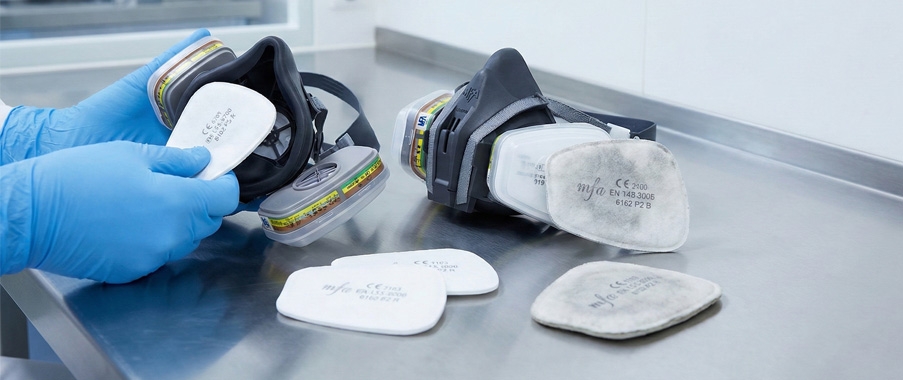
Respiratory protective mask filters have a specific service life. The filter lifespan shortens over time and depending on usage. In this case, filter replacement must be carried out. Thus;
- The employee’s respiratory tract is protected.
- The mask’s particle and gas retention capacity increases.
- Maximum safety is ensured even in the most risky environments.
- The breathing resistance of the mask decreases, making comfortable breathing possible.
How Is the Filter Replacement Process Determined for Respiratory Protective Masks?
The filter replacement process of protective masks is not dependent only on time. Usage-related and other factors are also among the most important determinants in this process. The primary factors can be listed as follows;
Manufacturer Instructions
Each brand has determined a “filter service life” for the protective masks it produces. In this context, elements such as usage hours, filter replacement periods, and maximum durability time are prioritized. Such information must be read carefully in the mask user manual.
Pollution Level of the Working Environment
The pollution level of the working environment affects the service life of the protective mask filter. Environments with high dust density, chemical gas levels, and humidity shorten the service life of mask components.
Mask Type and Filter Class
Protective masks are divided into two groups. In this context, particle filters are used for P1, P2, and P3 mask types. Gas/vapor filters are used in A, B, E, and K type masks. Therefore, the durability and service life of each mask class differ from one another.
Duration of Mask Usage
The daily working duration of protective masks is very important. Filters of masks used every day should be replaced within shorter periods.
Vital Warning: Filtered respiratory masks (gas, vapor, or particle-filtered masks) cannot be used when the oxygen level in the ambient air drops below 19.5%. If the oxygen level is below this value, even the highest-performance filters do not provide protection. In such environments, only supplied-air or self-contained breathing apparatus should be used.
Signs Indicating That the Mask Filter Needs to Be Replaced
There are some important signs that require filter replacement in protective masks. Important symptoms and indicators during use must be known by users. If the following signs are observed, the mask filter should be replaced as soon as possible;
- Contamination of the inner surface of the mask.
- Difficulty in breathing.
- Chemical odors coming from the mask.
- Feeling dust and particle penetration during mask use.
- Physical damage to the mask filter.
- Excessive sweating and feeling of heat beyond normal levels.
Important Warning: Smelling chemical odors from the mask is not an early warning for filter replacement. If an odor is detected, the filter has usually reached or exceeded its protective capacity. In addition, some hazardous gases (such as Carbon Monoxide – CO) are odorless, and some chemicals can quickly dull the sense of smell. Therefore, filter replacement should not rely solely on odor; manufacturer instructions and usage duration should be taken as the basis.
What Is the Average Filter Replacement Interval for Protective Masks?
The replacement period of different filter types will also vary. The average replacement periods according to filter type are as follows;
- P3 filters → Within 1–4 weeks.
- Gas filters → Between 8–40 hours.
- P2 filters → Within 1–2 weeks.
- Disposable masks → Must be discarded after daily use.
Note: The specified filter replacement periods are average values. Depending on pollutant concentration, humidity level, and usage duration, the filter life may be exhausted much sooner.
How Should the Filter Replacement Method Be Determined?
The filter replacement processes of masks should be carried out through general reporting. In this context;
- The environment where the mask is used should be identified,
- Daily usage duration should be reported,
- The filter type should be determined,
- The job definition should be made, and periodic replacement planning should be carried out accordingly.
In addition to what is written here, if situations such as chemical odor from the filter or breathing difficulty are detected, the filter section must be replaced immediately.
Similar Content
-
 Gas Mask Selection Guide
 -
 How to Choose a Gas Mask Filter?
 -
 Why Does Your Mask Become Ineffective?
 -
 Invisible Danger: Why Do All Mask Standards Say "0.3 Micron"?
 -
 Mask Certifications Guide: Who Are You Entrusting Your Breath To?
 -
 Special Respiratory Masks for Chemical Environments
 -
 How Are Masks Cleaned and Maintained?
 -
 When Should the Filter Replacement Period Be for Masks?
 -
 In Which Sectors Are Respiratory Protective Equipment Used?
 -
 How Should Mask Usage Training Be Provided to New Employees?