22 Dec 2025
In Which Sectors Are Respiratory Protective Equipment Used?
Respiratory protective equipment is used in many different sectors that threaten human health. Especially in environments where gases, vapors, dust, and harmful particles are present, respiratory protective equipment is of vital importance.
Accordingly; in industrial production, the healthcare sector, chemical laboratories, agricultural activities, and many other areas, respiratory protective masks are used. In order to prevent occupational accidents and long-term occupational diseases, the correct selection and use of masks is very important.
What Is Respiratory Protective Equipment?
Respiratory protective equipment is a mask and filter system designed to protect the respiratory tract against dust, smoke, harmful gases, chemical vapors, and biological contents. Depending on the environment in which it is used, there are various types of specialized respiratory masks.
Main Sectors Where Respiratory Protective Equipment Is Used
Protective masks can be used in many different fields. The main sectors in this scope are as follows;
Healthcare and Medical Sector
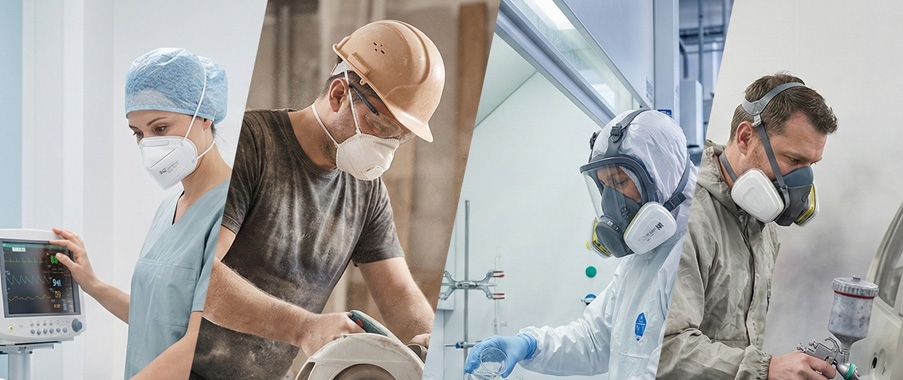
In hospitals, laboratories, sterile production areas, and similar places, N95 and similar particle-filtering masks are used. This type of mask, which is effective against biological risks, minimizes the risk of virus and bacterial transmission.
Chemical Industry
In chemical factories and laboratories; harmful gases and vapors occur during the production, storage, and application processes of chemical substances. Filtered respiratory masks are used as a mandatory measure in this sector.
Construction and Site Areas
In processes such as crushing, carrying, concrete pouring, and demolition within construction sites, large amounts of dust and particles are generated. In order to protect the health of employees, dust masks and particle-filtering respirators are used.
Paint and Coating Sector
Toxic vapors are released in spray paints and solvent-based chemical applications. To prevent these from harming the employee, masks with organic vapor filters are used.
Mining and Metal Industry
There is a risk of dust, smoke, and heavy gases in underground mines, foundries, and metal processing areas. This work area is among the places where occupational diseases are most frequently seen. To protect the health of the employee, respiratory protection equipment must be used.
Food and Agriculture Sector
In agricultural activities such as spraying, fertilizing, and production, chemical and biological risks occur. In such applications, the use of respiratory protective equipment is very important.
Oil and Energy Sector
People working in oil and energy facilities may be exposed to flammable and toxic gases. Especially full-face masks and special filter systems minimize the risks in this field.
Textile and Production Workshops
In the textile sector, dust masks are generally used. Thus; cotton dust, cutting particles, and textile chemicals do not affect the health of employees.
Firefighting and Emergency Response
Especially firefighters work in smoky environments by inhaling toxic gases. People in this field must use self-contained breathing apparatus (SCBA) that provides clean air.
Important Warning: Carbon monoxide (CO) gas is colorless, odorless, and extremely toxic. Standard gas and vapor filters (A, B, E, K type filters) do not provide protection against carbon monoxide gas. In environments with CO risk, only self-contained breathing apparatus (SCBA) should be used.
Waste Management and Recycling
Hazardous gases are released in chemical recycling facilities, waste sorting centers, and landfill areas. To prevent these from harming human health, the use of respiratory protective masks is necessary.
How to Choose the Right Respiratory Protection?
Care must be taken when choosing respiratory protective equipment. Mask preference must be made by taking the sector’s risks into consideration. At this point, the following criteria are very important;
- The type of hazardous substance present in the environment, such as dust, gas, and chemicals, should be determined.
- Filter classes and standards such as P1, P2, P3, ABEK, etc. should be known.
- Mask types such as half-face, full-face, and powered systems should be known.
- Protective masks must comply with standards such as CE and EN.
- Manufacturer instructions should be carefully read.
- The use and maintenance processes of protective masks should be learned.
Respiratory protective equipment is of great importance for many different sectors. The correct mask selection should be made according to the sector and the risk factors within it. At the same time, it is very important that regular inspections and maintenance of the masks are carried out completely. In this way, a healthy working environment will be created for everyone.
Similar Content
-
 Gas Mask Selection Guide
 -
 How to Choose a Gas Mask Filter?
 -
 Why Does Your Mask Become Ineffective?
 -
 Invisible Danger: Why Do All Mask Standards Say "0.3 Micron"?
 -
 Mask Certifications Guide: Who Are You Entrusting Your Breath To?
 -
 Special Respiratory Masks for Chemical Environments
 -
 How Are Masks Cleaned and Maintained?
 -
 When Should the Filter Replacement Period Be for Masks?
 -
 In Which Sectors Are Respiratory Protective Equipment Used?
 -
 How Should Mask Usage Training Be Provided to New Employees?