16 Dec 2025
How Is the Cleaning and Maintenance of Respiratory Protective Equipment Performed?
Respiratory protective equipment used in industrial facilities, healthcare institutions, and chemical environments protects employees against harmful factors such as gases, dust, particles, and chemicals. For efficient use and human health, proper cleaning and maintenance procedures must be carried out. In this way, the performance of the equipment increases, its service life is extended, and human health is protected.
How Is a Respiratory Mask Cleaned?
Gas mask cleaning should be performed at regular intervals. Daily and routine cleaning procedures can be carried out by users who have received the necessary training. However, procedures requiring part replacement, valve inspection, and periodic technical maintenance must be performed by authorized and expert personnel. The step-by-step cleaning process is as follows;
Use of Warm Water and Neutral Detergent
The entire surface of the mask should be cleaned using warm water and a neutral pH detergent. The use of cleaning agents containing excessive chemicals may damage the mask.
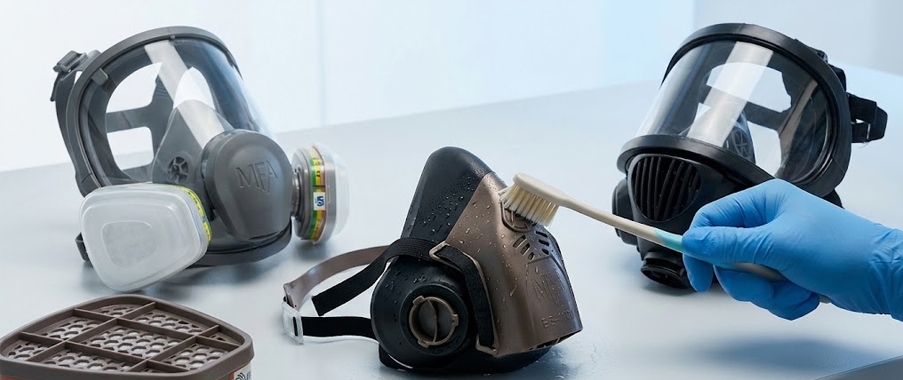
Cleaning with a Soft Brush
Dirty areas on the surface of the mask should be gently cleaned with a soft brush.
Rinsing After Cleaning
After the cleaning process is completed, the mask should be thoroughly rinsed so that no detergent residue remains.
Final Stage: Natural Drying Method
After the cleaning process is completed, the mask should be left to dry in a clean and well-ventilated environment away from direct sunlight. Any heaters or high heat sources must not be used.
How Is the Maintenance of Respiratory Protective Equipment Performed?
Regular maintenance of respiratory protective equipment extends the service life of the materials. For healthier and more functional use, the maintenance process should be as follows;
- The outer surface should be gently wiped without causing damage.
- A soft brush should be used to clean dusty filters.
- The usage period of the filters should be checked.
- Filters that have reached the end of their service life must be replaced.
- Filters of protective equipment used in chemical environments should be replaced at shorter intervals.
What Are the Maintenance Checks for Respiratory Protective Equipment?
Respiratory mask inspections should be carried out every day, especially during intensive use. The routine checklist that must be considered is as follows;
- Are there any cracks, tears, or deformations on the surface of the mask?
- Are the mask straps and harnesses intact?
- Is the elasticity level of the sealing gaskets sufficient?
- Is there any looseness at the connection points?
- Are the valves clogged?
How Should Respiratory Protective Masks Be Stored?
Proper storage of respiratory protective masks is as important as cleaning and routine maintenance. This way, the service life of the equipment is extended and the hygiene level is maintained.
- The storage area should be dry and cool and should not be exposed to direct sunlight.
- They must be kept away from environments containing chemical substances.
- They should be stored in a closed, dust-free container.
- Filters must be stored in airtight bags.
Mistakes Made in the Cleaning and Maintenance of Respiratory Protective Equipment
There are some mistakes made in the cleaning and maintenance of respiratory protective equipment. The mistakes that reduce the protective properties of the equipment and have harmful consequences are as follows;
- Allowing filters to come into direct contact with water.
- Washing the mask with bleach or similar heavy chemicals.
- Drying with high-temperature heaters.
- Leaving the mask under direct sunlight after washing.
- Touching the mask with dirty hands.
- Continuing to use deformed equipment that has lost its properties.
Why Is Regular Cleaning of Respiratory Protective Equipment Important?
Respiratory protective equipment consists of highly sensitive materials. These materials must be cleaned and maintained regularly. Thanks to regular cleaning;
- Filters work more efficiently.
- Masks fit the face properly and provide sealing.
- Health problems such as bacteria and virus formation are prevented.
- The service life of respiratory protective equipment is extended.
- User health is protected and occupational safety is ensured.
Similar Content
-
 Gas Mask Selection Guide
 -
 How to Choose a Gas Mask Filter?
 -
 Why Does Your Mask Become Ineffective?
 -
 Invisible Danger: Why Do All Mask Standards Say "0.3 Micron"?
 -
 Mask Certifications Guide: Who Are You Entrusting Your Breath To?
 -
 Special Respiratory Masks for Chemical Environments
 -
 How Are Masks Cleaned and Maintained?
 -
 When Should the Filter Replacement Period Be for Masks?
 -
 In Which Sectors Are Respiratory Protective Equipment Used?
 -
 How Should Mask Usage Training Be Provided to New Employees?