14 Dec 2025
Which Mask Is Used in Industrial Environments?
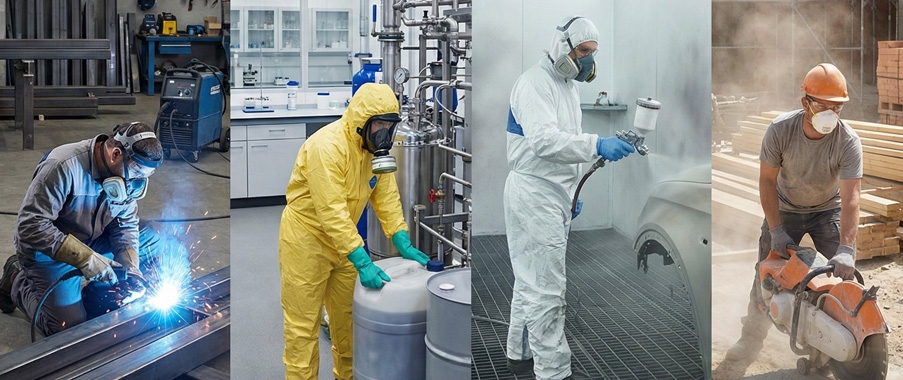
Industrial working environments contain elements that may pose risks to employee health. Air pollution, chemical vapors, metal fumes, particulate pollutants, and biological risks enter the body through respiration and create vital risks.
In order to prevent all of these, protective masks suitable for industrial environments must be used. Choosing the right mask according to the working environment is very important in terms of occupational safety and legal requirements.
What Are the Types of Industrial Masks?
Respiratory protective masks are divided into two main categories according to the risk level and the type of contaminant;
Particle Filter Masks
They provide protection against solid particles in the air such as dust, smoke, aerosol and fibers. The usage standards of particle filter masks can be listed as follows:
- FFP1: Used in low-level dusty environments.
- FFP2: Provides protection against medium-level dust, smoke and aerosols.
- FFP3: Used in environments with high-risk particles.
Areas of use of particle filter masks:
- Construction and demolition work areas.
- Environments with intense gypsum, cement and steel dust.
- Textile production facilities.
- Food and pharmaceutical production sites.
- Wood processing centers.
Gas and Vapor Filter Masks
Gas and vapor filter masks, which provide effective protection against chemical gases and vapors, have replaceable cartridges. The filtering model of the mask is as follows;
- A: Organic gases and vapors
- B: Inorganic gases
- E: Acid gases
- K: Ammonia and derivatives
- AX: Low boiling point organic compounds
Areas of use of gas and vapor filter masks;
- Areas where chemical contents are stored.
- Paint and solvent applications.
- Industrial cleaning activities.
- Laboratory environments.
- Facilities where chemical contents are produced.
Things to Consider When Choosing a Mask in an Industrial Environment
Choosing a protective mask in an industrial environment depends on various factors. In mask selection, the following criteria must be considered;
Risk Analysis Must Be Performed!
It is very important to determine against which risks protective masks will be used. In this context, the following questions must be answered:
- Particle?
- Chemical gas?
- Vapor?
- Biological risk?
Vital Warning: Respiratory masks with gas, vapor or particle filters cannot be used when the oxygen level in the ambient air drops below 19.5%. In such environments, filtered masks do not supply oxygen and a serious risk of suffocation occurs. In areas with low oxygen levels, only supplied-air or self-contained breathing apparatus should be used.
Protective Mask Standard Certificates
The protective masks used must comply with standards such as EN 149 and EN 140 / EN 136.
Filter Compatibility of the Mask
The filter type of industrial masks should be determined according to the work site where it will be used. At the same time, cartridge compatibility must also be checked according to the working area.
User Comfort Must Be Ensured in Long Use
If the mask will be used for a long period, the user’s comfort should also be taken into consideration. The most important factors in this regard are as follows;
- Fit of the mask to the face.
- User sweating condition.
- Effect of the mask on breathing.
- Mask weight.
Training and Test Process
Before using a protective mask, the necessary training must be provided to the person and tests must be applied. During use, fit test verification must also be performed. Incorrect wearing of the mask or a possible loss of function reduces the protective feature by 80%!
Important Warning: In order to provide effective protection in half-face and full-face respiratory masks, complete sealing between the face and the mask is required. This sealing cannot be achieved in employees with beards, mustaches or dense facial hair, and performed fit tests become invalid. Therefore, half-face and full-face masks do not provide effective respiratory protection for personnel with beards or dense facial hair.
Which Protective Mask Is Used in Which Sector?
The use of industrial protective masks can be determined by sectors as follows;
Chemical and Paint Industry Works: Full face mask with A, B and E class filter cartridges.
Construction and Mining Sector: FFP2 / FFP3 particle masks and full face mask with particle filter (in high dust).
Metal Industry and Welding: FFP3 particle mask and special filtered masks that provide protection against welding fumes.
Food and Pharmaceutical Production Areas: FFP2 masks and disposable masks needed in sterile environments.
Pesticide Spraying Operations: A class organic vapor filter and full face mask that provides eye protection.
Risks of Incorrect Mask Use in Industrial Environments
Employers are obliged to protect their personnel in accordance with Labor Law No. 4857, Occupational Health and Safety Law No. 6331, and also OSHA / European standards. In this context, especially in industrial environments, appropriate masks must be preferred and used correctly. The main risks that may occur in incorrect mask selection are as follows;
- Chemical burns that may occur in the body.
- Asthma and COPD diseases.
- Respiratory diseases.
- Eye and skin irritation.
- Exposure to carcinogenic factors.
What Is the Difference Between a Full Face Mask and a Half Face Mask?
Full face masks are preferred for environments where chemical risks are intense. These masks with respiratory protection also protect the eye and face area. Half face masks provide protection in particle-dominant environments.
Similar Content
-
 Gas Mask Selection Guide
 -
 How to Choose a Gas Mask Filter?
 -
 Why Does Your Mask Become Ineffective?
 -
 Invisible Danger: Why Do All Mask Standards Say "0.3 Micron"?
 -
 Mask Certifications Guide: Who Are You Entrusting Your Breath To?
 -
 Special Respiratory Masks for Chemical Environments
 -
 How Are Masks Cleaned and Maintained?
 -
 When Should the Filter Replacement Period Be for Masks?
 -
 In Which Sectors Are Respiratory Protective Equipment Used?
 -
 How Should Mask Usage Training Be Provided to New Employees?